
Understanding Metropolitan Redevelopment Areas
As Albuquerque grows and changes, long-established commercial corridors like San Pedro face a familiar challenge: how to reinvest in aging infrastructure, support existing businesses, and encourage thoughtful redevelopment—without losing the character, affordability, and local ownership that define the corridor.
One of the primary tools cities use to meet that challenge is a Metropolitan Redevelopment Area, or MRA.
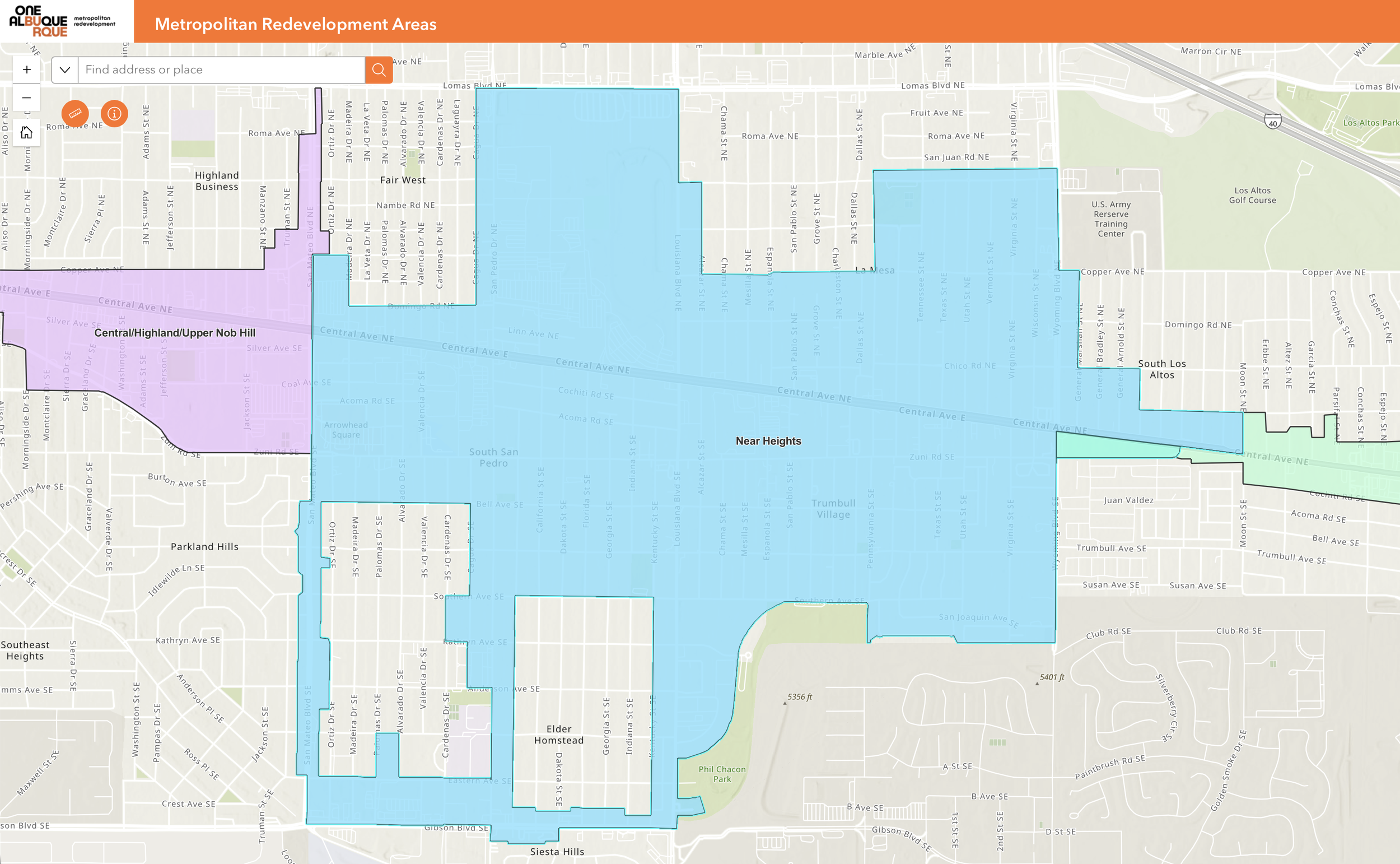
With an upcoming public meeting focused on a proposed extension of the Near Heights MRA, this Bulletin provides a clear, plain-language explanation of what MRAs are, how they work, and why this tool matters for revitalization along San Pedro Main Street.
Metropolitan Redevelopment Areas are not a silver bullet—but when understood and used carefully, they can be a powerful tool for supporting corridors like San Pedro as places to do business, build community, and invest for the long term.
What Is a Metropolitan Redevelopment Area?
A Metropolitan Redevelopment Area (MRA) is a revitalization framework created by a city and authorized under New Mexico state law. It allows a municipality to focus resources, incentives, and coordination efforts within a defined area where reinvestment is needed to support long-term economic health.
MRAs exist because cities recognize an important reality: many established corridors face systemic challenges that individual property owners or businesses cannot solve alone.
These challenges often include:
Aging infrastructure
Underutilized or vacant buildings
Fragmented ownership patterns
Higher costs for rehabilitation than new development
Limited access to capital for small and local owners
An MRA gives the City a way to intentionally support reinvestment in existing neighborhoods, rather than defaulting to outward expansion or greenfield development.
How MRAs Are Created and Governed
MRAs are:
Initiated by the City, not private developers
Authorized by state statute
Approved by elected officials through a public process
Bound by a specific geographic boundary and time period
Once established, MRAs are administered by the City and guided by adopted redevelopment plans and policies. In Albuquerque, redevelopment activities within MRAs are reviewed and advised by the Albuquerque Development Commission, ensuring public oversight and accountability.
An MRA does not dictate what must happen in an area. Instead, it creates a policy and financial framework that allows the City to respond strategically when opportunities arise.
In Albuquerque, MRAs are administered by the Metropolitan Redevelopment Agency (https://www.cabq.gov/mra).
What Tools an MRA Makes Available
An MRA allows the City to use tools that are not otherwise available under standard municipal authority. These tools can include:
Targeted public infrastructure investment such as:
the use of Tax Increment Financing to pool gross receipts and property tax for reinvestment back into the area it generated from
Redevelopment incentives to help close financing gaps including:
7 yr tax abatement
Property Improvement Programs and other grant programs
Waiver of certain public fees to lower the cost of development
Support for public–private partnerships
Strategic coordination around land use, transportation, and utilities
Land banking (the City can purchase, hold, and grant property to future projects).
Long-term planning that aligns public investment with community priorities
These tools are used selectively and must meet established criteria. They are designed to reduce barriers to reinvestment, not to subsidize speculative development.
Clearing Up Common Misunderstandings
MRAs are best understood as enabling tools, not mandates. Because MRAs involve public policy and redevelopment, they are often misunderstood. A few important clarifications:
MRAs do not:
❌ Raise property taxes
❌ Change zoning automatically
❌ Force property owners to sell
❌ Allow development without public review
Any redevelopment project within an MRA must still comply with:
Existing zoning and land-use regulations
Public hearing and approval processes
City design, safety, and environmental standards
Metropolitan Redevelopment Areas: Myths & Facts
MYTH: An MRA means my property taxes will go up.
FACT: An MRA does not raise property taxes. Property tax rates are set separately through existing tax policy and voter-approved measures. Being located within an MRA does not change how your property is taxed.
MYTH: The City can force property owners to sell if an area becomes an MRA.
FACT: An MRA does not require property owners to sell or redevelop. Participation in redevelopment projects is voluntary, and property ownership remains unchanged.
MYTH: An MRA automatically changes zoning or allows bigger buildings.
FACT: An MRA does not change zoning. Any zoning changes or development proposals must still go through the City’s normal public review and approval processes.
MYTH: MRAs only benefit large developers.
FACT: MRAs are commonly used to support small and locally owned businesses, legacy properties, and incremental reinvestment—especially in established Main Street corridors where redevelopment costs can be high.
MYTH: Once an MRA is approved, projects move forward without public input.
FACT: Redevelopment projects within an MRA still require public oversight, including City review, compliance with adopted plans, and approval processes involving the Albuquerque Development Commission.
MYTH: An MRA guarantees that redevelopment will happen.
FACT: An MRA does not guarantee development. It provides tools the City can use if and when opportunities arise, based on market conditions and community priorities.
MYTH: This public meeting is where final decisions will be made.
FACT: The upcoming meeting is informational only. Its purpose is to explain the proposal, answer questions, and gather feedback—not to approve projects or finalize outcomes.
Why MRAs Matter for the San Pedro Main Street Corridor
San Pedro Main Street is a corridor defined by small businesses, long-time property owners, and neighborhoods that rely on it for daily services—not a single large redevelopment project. That makes corridor-scale tools especially important. An MRA can help:
Support reinvestment in existing buildings
Improve streets, sidewalks, lighting, and utilities that serve everyone
Encourage business retention and expansion
Reinforce walkability and safety improvements
Align public investment with Main Street revitalization goals
Rather than focusing on isolated projects, MRAs allow the City to take a long-term, coordinated approach—one that complements local organizing and private reinvestment already happening along San Pedro.
MRAs and the Main Street Approach
MRAs work best when paired with community-based revitalization strategies like the Main Street Approach, which emphasizes:
Design – improving the physical environment
Economic Vitality – strengthening local businesses
Organization – coordinating partners and resources
Promotion – reinforcing corridor identity and activity
Used thoughtfully, an MRA can help align municipal tools with these principles—supporting revitalization that is incremental, locally grounded, and responsive to community needs.
The Near Heights MRA Extension Proposal
The City of Albuquerque is proposing to extend the existing Near Heights MRA to include additional areas along San Pedro Drive. The intent is to expand the City’s ability to support reinvestment and infrastructure improvements in this portion of the corridor.
The upcoming public meeting is intended to:
Share information about the proposal
Explain what tools an MRA provides
Answer questions from business owners, property owners, and residents
Clarify next steps and timelines
This meeting is informational only. No final decisions will be made at the meeting.
RSPP’s Role
The Revitalize San Pedro Partnership (RSPP) serves as a community-based intermediary for the corridor. In this process, RSPP’s role is to:
Help translate public policy tools into plain language
Create space for informed community discussion
Elevate corridor priorities and concerns
Support transparency and early engagement
Our focus is ensuring that decisions affecting San Pedro are made with a clear understanding of local conditions and long-term community goals.
Participate and Stay Informed
Public Meeting: Near Heights MRA Extension Proposal
📅 Tuesday, January 13, 2026 | 6:00–7:30 PM
📍 Revitalize San Pedro Partnership Office | 1307 San Pedro Dr NE, Albuquerque, NM 87110
🔗 Event details: https://www.sanpedroabq.org/events/public-meeting-near-heights-mra-extension-proposal
Community members are encouraged to attend and to submit questions in advance to connect@sanpedroabq.org.